English
 العربية

Changes in Mesophotic Reef Fish Assemblages Along Depth and Geographical Gradients in the Northwestern Hawaiian Islands
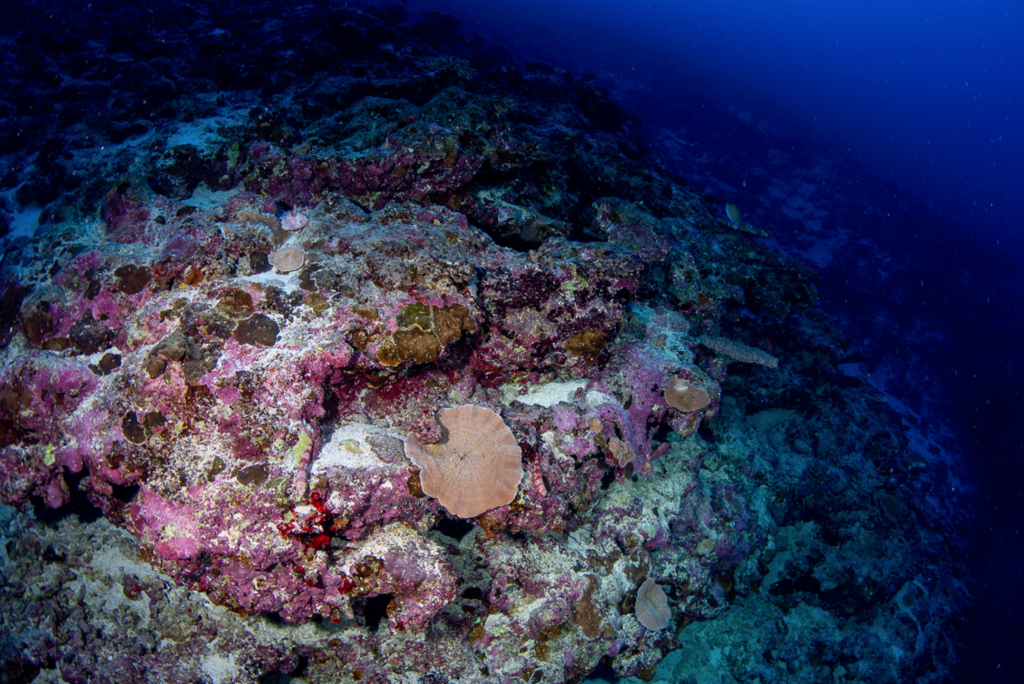
While most people think of coral reefs as shallow, sunny underwater gardens, corals and their fish extend far deeper into the ocean. These deeper habitats — known as mesophotic coral ecosystems (MCEs) — are found roughly 30 to 150 meters below the surface. Because they receive less light than shallow reefs but are still within the sunlit zone, mesophotic reefs support unique communities of corals, algae, and reef fish. Scientists are particularly interested in them because they might act as refuges for reef organisms when shallow reefs face stress from warming oceans, storms, or human impacts. However, until recently, the fish communities living in these deeper reefs of Hawai‘i were not well documented. (Springer)
To investigate, researchers led by Atsuko Fukunaga and colleagues conducted surveys of fish communities across different depths (27–100 meters) and along the geographic gradient of the Northwestern Hawaiian Islands (NWHI) — a chain of islands and atolls northwest of the main Hawaiian Islands that is part of the Papahānaumokuākea Marine National Monument. These waters are among the most remote and least disturbed coral reef systems on Earth, providing a special opportunity to study how fish communities vary naturally with depth and location. (Springer)
Why Study Mesophotic Reef Fish Assemblages?
Mesophotic reefs are interesting for several reasons:
- They exist at depths deeper than typical snorkeling or recreational diving limits, meaning they are less studied but biologically diverse.
- They may be less affected by surface impacts like coral bleaching or storms.
- Their cooler, more stable environmental conditions could support different fish communities compared to shallower reefs.
Understanding how fish communities change with depth and location helps scientists learn about ecosystem connectivity, biodiversity, and resilience. (Springer)
Methods: Surveying the Twilight Zone
To collect data, researchers used technical diving approaches, including both open‑circuit and closed‑circuit systems, to reach depths down to 100 meters. Divers recorded all conspicuous reef fish species along https://coralfishhawaii.com/ transects at multiple sites across nine islands and atolls, from the southeastern end of the NWHI to the far northwestern atolls. They counted species and individuals at each depth and location, then analyzed patterns across the region. (Springer)
Key Findings: Depth and Location Shape Reef Fish Communities
The study found clear patterns in fish community structure across both depth and geography:
- Depth Matters:
- Fish communities changed significantly from shallower mesophotic depths down toward deeper sites.
- Certain types of fish — especially invertivores (which eat invertebrates) and herbivores (algae eaters) — decreased in abundance with increasing depth.
- At deeper mesophotic depths, fish assemblages were less dominated by herbivores and more influenced by other feeding groups.
- These changes likely reflect environmental shifts such as light availability, temperature, and habitat structure as depth increases. (Springer)
- Geography Matters:
- Fish communities also differed among islands and atolls along the NWHI.
- The southeastern islands had notable populations of an introduced snapper species (Lutjanus kasmira), which was present there but largely absent farther northwest.
- In contrast, the northwestern atolls — such as Midway and Kure — were dominated by species endemic to Hawai‘i, meaning they are found nowhere else on Earth. In some deep sites, over 80 % of fish individuals belonged to endemic species. (Springer)
- Combined Effects:
- Depth and location interacted: some species were associated with specific depth ranges and specific areas of the island chain. For example, several invertivores were more abundant at shallower mesophotic sites in the southeastern NWHI than deeper or northern locations. (Springer)
Why These Patterns Occur
A major factor behind the observed patterns is likely environmental variation. As water depth increases, light decreases, temperature drops, and habitats become less complex. These changes influence which species can thrive. Likewise, differences in water temperature along the length of the NWHI — warmer in the southeast and cooler in the northwest — appear to influence fish distributions and the presence of endemic species. (Springer)
Implications for Reef Conservation
This research highlights the biological uniqueness of mesophotic reef fish communities — particularly the importance of endemic species in deeper waters — and underscores the value of conserving these less‑studied ecosystems. Management strategies that consider both depth and spatial differences are important for protecting the full range of marine biodiversity in Hawai‘i’s reefs.