English
 العربية

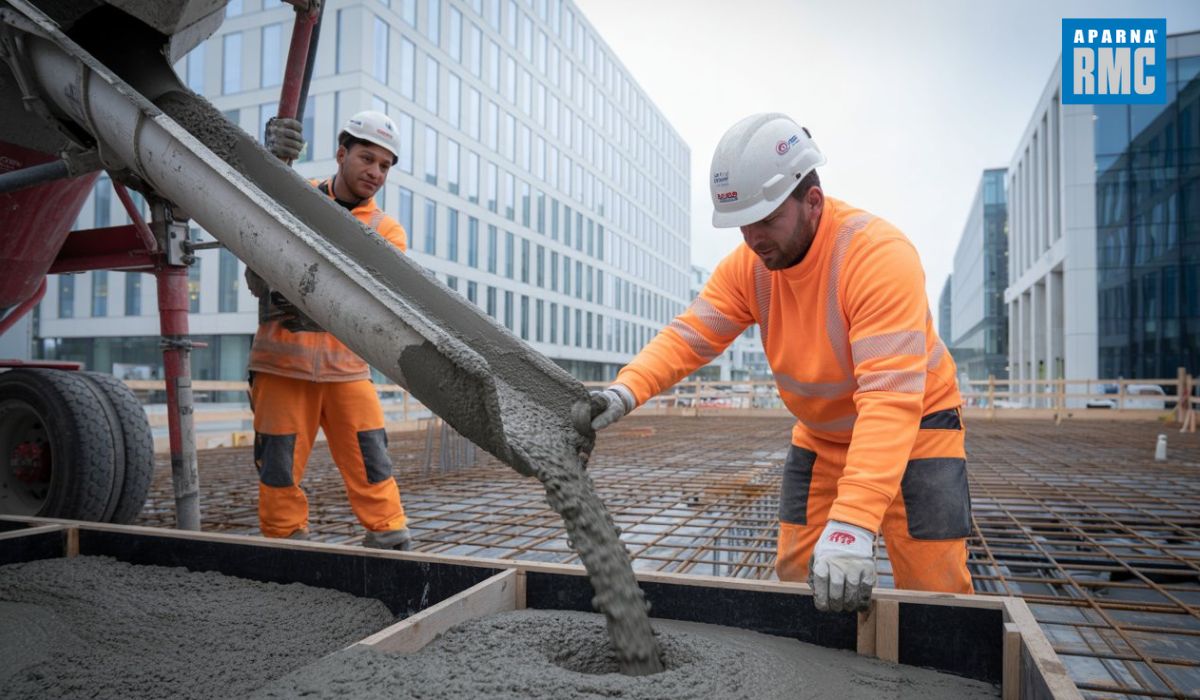
Walk past any major construction site in India today — a rising residential tower, a new metro depot, or a government-funded highway project — and you will almost certainly find a transit mixer somewhere in the frame.
That orange-and-grey drum, slowly rotating as it moves through city traffic, carries something that has quietly become essential to how India builds: Ready Mix Concrete.
Over the past decade, the adoption of RMC across urban and semi-urban construction has accelerated remarkably. Developers, contractors, and government project managers are increasingly making the shift — not because it is fashionable, but because it simply delivers better results.
This article explores why Ready Mix Concrete has become central to the modern construction industry, what genuine benefits it brings to different types of projects, how it connects to the goals of sustainable construction, and where this industry is headed in the years to come.
Why Ready Mix Concrete Matters More Than Ever in Modern Construction
For much of India’s construction history, concrete was mixed on-site. A gang of workers, a drum mixer, a few bags of cement, some aggregate and sand, and water — this was the standard method.
It worked. But it came with limitations that have become harder to overlook as construction demands have grown more complex.
Site-mixed concrete depends heavily on manual inputs. The ratio of ingredients can vary from batch to batch. Workers may inadvertently add too much water to make the mix more pourable. Temperature, humidity, and the quality of locally sourced aggregate all affect the outcome in ways that are difficult to control.
Ready Mix Concrete changes this equation entirely.
Manufactured in calibrated batching plants, RMC is produced using precise measurements, quality-tested raw materials, and automated processes. The result is a consistent, reliable product that meets the structural specifications your engineer has designed for — every single time.
In the modern construction industry, where projects are larger, timelines are tighter, and structural accountability is greater, this consistency is not a luxury. It is a necessity.
The Real Benefits of Using High-Quality Ready Mix Concrete
Structural Strength You Can Depend On
The most important job concrete has to do is carry load. High-quality concrete, produced to the correct grade and water-cement ratio, does this with the reliability that structures demand over decades of use.
With RMC, the specified grade — whether M25 for a residential slab or M50 for a commercial high-rise column — is achieved consistently across every cubic metre delivered. There are no weak batches hidden somewhere in the structure.
Faster Construction Timelines
Time savings on-site are one of the most immediately visible benefits of RMC.
When your concrete is arriving ready to pour, there is no time lost in setting up mixing equipment, sourcing and storing raw materials, or supervising manual batching. The pour begins when the truck arrives. Labour is focused on placement and finishing — not on preparation.
For contractors managing multiple projects or working against penalty clauses, this is a meaningful operational advantage.
Less Wastage, Better Budget Control
Material wastage is a significant — and often underestimated — cost in construction. When concrete is mixed on-site, it is difficult to produce exactly the right quantity for each pour. The instinct is always to mix a little extra. That extra almost always goes to waste.
RMC is ordered and delivered in precise volumes. Over a large project, the reduction in material wastage can translate into savings that more than offset the per-unit cost difference compared to site-mixing.
Cleaner, More Organised Worksites
A site using RMC does not need to store large quantities of cement, sand, and aggregate. This reduces clutter, lowers the risk of material theft or spoilage, and makes the overall site easier to manage — particularly in urban construction zones where space is at a premium.
The Role of RMC in Commercial and Residential Construction
Commercial Projects: Where Precision Is Non-Negotiable
In commercial construction — office complexes, shopping centres, hospitals, hotels, and industrial facilities — the structural demands are significant and the tolerance for quality variation is near zero.
Large column loads, long-span beams, underground car parks, post-tensioned slabs — all of these require concrete grades and properties that must be precisely controlled. High-strength concrete mixes, self-compacting concrete for congested reinforcement, and pumpable mixes for high-rise pours are all specialised products that RMC batching plants are equipped to produce.
The civil and structural engineers on these projects specify concrete in detail. It is the RMC supplier’s responsibility to meet those specifications exactly. This is why the choice of RMC supplier is a critical procurement decision on any commercial project, not an afterthought.
Residential Construction: Quality for the Long Term
The case for RMC in residential construction is equally strong, though the conversation around it has taken longer to develop.
Individual homebuilders and small residential developers sometimes hesitate when they hear the price of RMC compared to what a local contractor quotes for site-mixing. But the comparison is rarely apples-to-apples.
When you factor in the quality of materials used, the elimination of manual error, the time saved in construction, and — most importantly — the long-term structural performance of the building, RMC consistently comes out ahead.
A family home is typically a once-in-a-generation investment. The concrete going into its columns, beams, and slabs needs to perform reliably for 50 years or more. That is not the place to economise on material quality.
Companies like Aparna Ready Mix Concrete have built their reputation by serving both the large commercial segment and residential builders with equally rigorous quality standards — making high-quality concrete solutions accessible across project scales.
Sustainable Construction and the Evolution of Concrete Technology
Sustainability has moved from the fringes to the mainstream of construction thinking — and concrete technology is evolving rapidly in response.
Ready Mix Concrete is well-positioned to contribute to sustainable construction in several meaningful ways.
Supplementary Cementitious Materials (SCMs): Modern RMC plants routinely incorporate fly ash, GGBS, or silica fume into their mixes. These industrial by-products partially replace Portland cement, reducing the carbon intensity of concrete without compromising — and in many cases improving — durability and long-term strength.
Reduced Over-specification: Precisely batched RMC discourages the common site practice of upgrading to a stronger mix “just to be safe.” Using exactly the grade that is structurally required reduces cement consumption across a project.
Water Efficiency: Controlled batching environments are far more disciplined about water management than site mixing. Many modern plants also recycle wash water from transit mixers, reducing overall freshwater consumption.
Longer-Lasting Structures: Perhaps the most significant sustainability contribution of high-quality concrete is that it lasts longer. A structure that stands for 80 years instead of 40 years represents an enormous saving in the embodied carbon of rebuilding.
For developers pursuing green building ratings — IGBC, LEED, or GRIHA — the use of certified, responsibly produced RMC can contribute meaningfully to the points tally.
Challenges in Construction and How Quality Concrete Addresses Them
The Indian construction industry faces a set of persistent challenges: labour unpredictability, site safety, quality accountability, and cost overruns. Well-sourced RMC addresses several of these in practical terms.
Labour dependency: Concrete mixing is one of the most labour-intensive activities on a traditional site. RMC reduces the headcount needed for this task, making projects less vulnerable to daily labour attendance fluctuations.
Quality disputes: When a structure develops a crack or a column shows signs of distress, establishing accountability is difficult with site-mixed concrete. With RMC, each delivery comes with a batch ticket and test data. Quality can be traced. This protects the contractor as much as the client.
Rework and delays: Poor concrete quality is one of the leading causes of rework in construction — a slab that doesn’t achieve its design strength, a pour that segregates, a surface that dusts. Quality RMC, placed and cured correctly, significantly reduces these rework incidents.
The Future of Ready Mix Concrete Industry in India
India’s infrastructure ambitions are enormous — and concrete sits at the heart of all of it.
The National Infrastructure Pipeline, highway expansion programmes, urban metro networks, new airport projects, affordable housing schemes under PMAY — all of these demand construction materials at scale and quality.
The RMC industry in India is growing to meet this demand. Batching plant capacity is expanding beyond the major metros into Tier 2 and Tier 3 cities. Digital technologies are entering the plant and the delivery process — GPS tracking of transit mixers, real-time batch monitoring, digital delivery documentation.
Concrete technology itself continues to advance. Ultra-high-performance concrete (UHPC), geopolymer concrete, 3D-printable concrete mixes — these are no longer just laboratory concepts. They are moving towards practical application on real projects.
The ready mix concrete industry in India is well-positioned to be the backbone of this construction future. Suppliers who invest in quality systems, sustainability practices, and technical capability will be the ones that serious project teams choose to work with.
Conclusion
Ready Mix Concrete has earned its central role in Indian construction on merit.
It delivers consistent quality that site-mixing cannot match. It saves time, reduces wastage, and supports the demands of modern structural engineering. It enables sustainable construction practices. And it is evolving — technically and operationally — to serve the increasingly ambitious projects that India’s infrastructure growth demands.
For anyone involved in building — a homeowner constructing a residence, a developer managing a commercial complex, or a contractor delivering an infrastructure project — understanding the value of high-quality RMC and choosing suppliers with proven standards is one of the most impactful decisions you can make.
Good buildings begin with good concrete. And good concrete begins long before the transit mixer reaches your site.
Frequently Asked Questions (FAQs)
Q1. What is the difference between Ready Mix Concrete and site-mixed concrete?
Ready Mix Concrete is manufactured in a controlled batching plant using precise ingredient ratios and delivered to the site ready to pour. Site-mixed concrete is prepared manually at the construction site. RMC offers superior consistency, quality control, and time efficiency compared to site-mixed alternatives, which are prone to human error and variable material quality.
Q2. Which concrete grade is suitable for residential construction?
For most standard residential construction in India, M20 to M30 grades are commonly specified. M20 is typically used for slabs and minor structural elements, while M25 and M30 are standard for beams and columns. The actual specification should always be confirmed by a qualified structural engineer based on the design loads and soil conditions of the specific project.
Q3. How does Ready Mix Concrete contribute to sustainable construction?
RMC contributes to sustainability in several ways: it incorporates supplementary cementitious materials like fly ash and GGBS that reduce cement consumption and carbon emissions; it minimises material wastage through precise batching; it reduces water overuse; and it produces stronger, more durable structures that have longer service lives — reducing the need for repair or demolition over time.
Q4. What should I check before finalising an RMC supplier for my project?
Key factors to evaluate include: proximity of the batching plant to your site (to ensure timely delivery within the concrete’s workability window); range of grades and specialised mixes available; quality certifications and testing protocols; track record on similar projects; and reliability of supply during peak construction periods. Ask for sample batch reports and cube test results.
Q5. Is Ready Mix Concrete a cost-effective choice for small residential projects?
While the per-cubic-metre price of RMC may appear higher than site-mixing at first glance, the full cost comparison includes savings on labour, raw material procurement, equipment, wastage, and rework. For most residential projects above a few hundred square feet of construction, RMC proves to be economical over the total project cost — and delivers a structurally superior outcome.