 English
 العربية

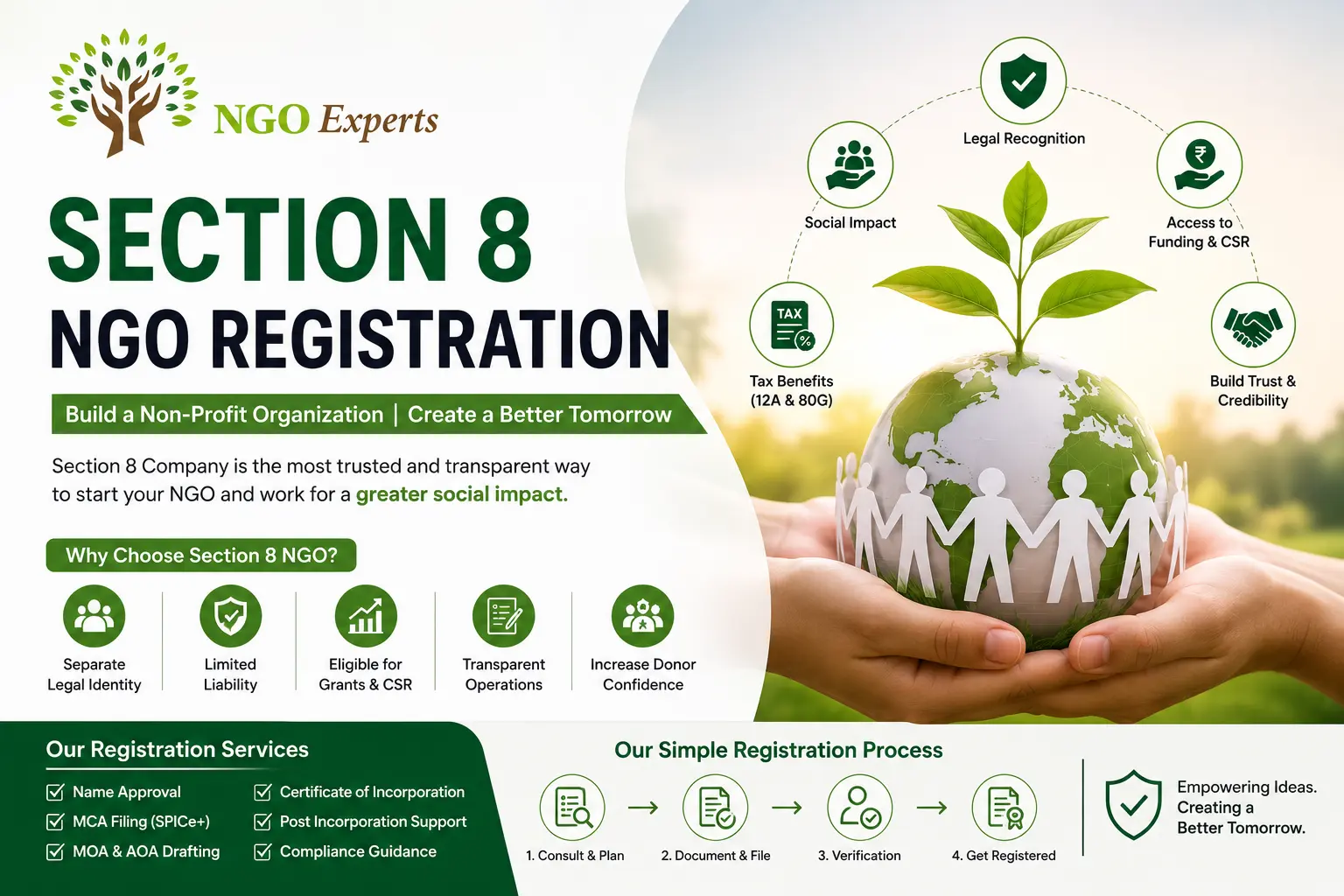
Introduction to Section 8 NGO Registration
Starting a non-profit organization in India requires proper legal registration to gain credibility, funding opportunities, and government recognition. One of the most trusted and professional ways to establish an NGO is through Section 8 NGO registration.
A Section 8 Company is registered under the Companies Act, 2013 and is formed for charitable purposes such as education, healthcare, environmental protection, social welfare, women empowerment, rural development, and other non-profit objectives.
This guide explains everything about the registration process, benefits, documents, eligibility, compliance, and fees related to Section 8 company registration in India.
What is a Section 8 Company?
A Section 8 Company is a legal non-profit organization created to promote charitable and social objectives without distributing profits among members.
The income and profits earned by the organization are used only for promoting its objectives and activities.
Objectives of a Section 8 NGO
A Section 8 NGO can work in areas such as:
Education and Skill Development
Organizations can provide educational support, training programs, and awareness campaigns.
Healthcare and Medical Relief
NGOs can organize health camps, awareness drives, and medical support programs.
Environmental Protection
Activities may include tree plantation drives, sustainability projects, and environmental awareness.
Women and Child Welfare
Section 8 NGOs often work for women empowerment and child protection initiatives.
Rural Development
Programs related to employment, sanitation, and rural education can be conducted.
Why Choose Section 8 NGO Registration?
Many organizations prefer Section 8 NGO registration because it provides higher transparency and legal recognition compared to other NGO structures.
Separate Legal Identity
The organization gets a separate legal existence from its members.
Better Credibility
Section 8 Companies are considered highly trustworthy by donors, government authorities, and corporate organizations.
Eligibility for CSR Funding
Many companies prefer donating CSR funds to registered Section 8 NGOs.
Tax Benefits
A registered NGO can apply for:
12A Registration
Provides income tax exemption to the NGO.
80G Registration
Allows donors to claim tax deductions on donations.
Limited Liability Protection
Members and directors generally have limited liability protection.
Eligibility Criteria for Section 8 NGO Registration
Before starting the registration process, applicants must fulfill certain conditions.
Minimum Directors Required
Private Section 8 Company
Minimum 2 directors are required.
Public Section 8 Company
Minimum 3 directors are required.
Charitable Objective
The organization must work only for non-profit and charitable purposes.
No Profit Distribution
Profits cannot be distributed among members or directors.
Documents Required for Section 8 NGO Registration
Proper documentation is important for smooth approval.
Identity Proof of Directors
- PAN Card
- Aadhaar Card
- Passport
- Voter ID
Address Proof
- Electricity bill
- Bank statement
- Telephone bill
Registered Office Proof
- Rent agreement or ownership proof
- NOC from property owner
Passport Size Photographs
Photographs of all directors and members are required.
Step-by-Step Process of Section 8 NGO Registration
Understanding the registration process helps avoid delays and rejections.
Step 1: Obtain Digital Signature Certificate (DSC)
All directors must obtain a DSC for online filing and verification.
Step 2: Apply for Director Identification Number (DIN)
DIN is mandatory for every director of the company.
Step 3: Reserve the Company Name
The organization must choose a unique and meaningful name related to its objectives.
Important Tips for Name Selection
- Avoid trademark conflicts
- Avoid government-related words
- Use charitable terms carefully
Step 4: Draft MOA and AOA
Memorandum of Association (MOA)
Defines the objectives and scope of the NGO.
Articles of Association (AOA)
Defines internal rules and management structure.
Step 5: File SPICe+ Form on MCA Portal
The registration application is submitted through the MCA portal with all required documents.
Step 6: Verification and Approval
The Registrar of Companies verifies the documents and application.
Step 7: Receive Certificate of Incorporation
After approval, the Section 8 Company receives its incorporation certificate.
This officially completes the Section 8 NGO registration process.
Section 8 NGO Registration Fees
The registration cost depends on various factors.
Government Fees
Government filing charges vary based on authorized capital and application type.
Professional Fees
Professional charges may include:
- Documentation
- DSC assistance
- MCA filing
- Legal consultation
Approximate Total Cost
The overall registration cost generally ranges between ₹12,000 to ₹40,000 depending on services and compliance requirements.
Time Required for Registration
The complete process generally takes:
Estimated Timeline
10 to 25 working days
The timeline may vary depending on document verification and approvals.
Compliance After Section 8 NGO Registration
After incorporation, NGOs must maintain proper legal compliance.
Annual ROC Filing
Annual returns and financial statements must be filed regularly.
Accounting and Audit
The organization must maintain proper books of accounts and audits.
Income Tax Compliance
Tax filings and exemption-related compliance are mandatory.
FCRA Compliance
NGOs receiving foreign donations must obtain FCRA registration.
Difference Between Section 8 Company, Trust, and Society
| Feature | Section 8 Company | Trust | Society |
|---|---|---|---|
| Governing Law | Companies Act | Trust Act | Societies Act |
| Transparency | High | Moderate | Moderate |
| Credibility | Very High | Medium | Medium |
| CSR Funding Preference | High | Medium | Medium |
| Compliance Level | Higher | Lower | Moderate |
Advantages of Section 8 NGO Registration Online
Digital registration systems have simplified the process significantly.
Faster Registration Process
Online filing reduces manual delays.
Better Transparency
Applicants can track application status digitally.
Reduced Paperwork
Most documentation can be submitted online.
Nationwide Accessibility
Applicants from any state in India can apply conveniently.
Common Mistakes During Registration
Avoiding these mistakes can save time and money.
Incorrect Documentation
Improper or incomplete documents can delay approval.
Wrong Objective Drafting
Improper charitable objectives may lead to rejection.
Choosing Similar Names
Duplicate or trademarked names may not get approval.
Ignoring Compliance Requirements
Non-compliance can attract penalties and legal issues.
Who Should Opt for Section 8 NGO Registration?
This structure is ideal for:
- Charitable organizations
- Educational institutions
- Healthcare NGOs
- CSR initiatives
- Social welfare organizations
- Environmental groups
- National-level NGOs
Conclusion
Choosing Section 8 NGO registration is one of the best options for organizations planning to work professionally in the non-profit sector. It provides legal recognition, better transparency, tax benefits, and improved funding opportunities.
With growing CSR investments and increasing awareness about social welfare initiatives, Section 8 Companies are becoming the preferred NGO structure in India.
Proper documentation, legal compliance, and professional guidance can help complete the registration smoothly and establish a strong foundation for long-term social impact.
Click here to know more about this.